












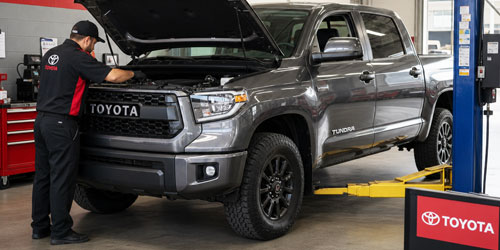
Owners of the 2025 Toyota Tundra are encountering dead battery issues, frequently attributed to parasitic draw, or an abnormal electrical drain, with certain cases documenting battery depletion within 24 hours to several weeks of vehicle inactivity.
What Is a Parasitic Draw?
A parasitic draw develops when electrical components persist in drawing battery power following truck shutdown. Contemporary vehicles inherently draw a minimal amount of electricity to maintain memory configurations, security mechanisms, and onboard computing systems. Nevertheless, abnormal draw can swiftly deplete the battery and render the vehicle incapable of starting.
Common Causes of Battery Drain in the 2025 Toyota Tundra
- Key Fob Proximity: Storing the key fob within detection range — for instance, within an adjacent garage or entrance area — can maintain the truck’s computer in an active state.
- Defective Battery/Component: Certain owners discovered that the factory-installed battery was already deteriorating, or that a malfunctioning alternator was inadequately restoring battery charge throughout vehicle operation.
- Aftermarket Equipment Installation: Supplementary equipment like dash cameras, dashboard recording devices, GPS monitoring devices, remote starting, security alarms or sound system can generate an inappropriate load on the electrical network.
- Door/Interior Lights: Defective door switches maintaining cabin illumination active, or other continuously-running modules, can deplete the battery.
Troubleshooting
- Diagnosis: A parasitic draw assessment using a multimeter should indicate a draw of less than 0.05–0.06 amps following the truck’s computers entering sleep mode, which may require an hour.
- Voltage Drop Test: Measuring the voltage across fuses (without removing them) can pinpoint which circuit is consuming power.
Temporary Fixes for Owners of Affected Tundra Models
Pending proper resolution of the problem, certain owners have implemented provisional alternatives including:
- Employing a battery maintenance device or low-amperage charger
- Incorporating a battery maintainer or isolation switch
- Parking the vehicle at greater distance from the key fob
- Eliminating supplementary equipment installations
- Operating the vehicle with increased regularity to sustain charge capacity
What Your Toyota Dealership Can Do To Fix This Issue
Identifying battery depletion complications presents challenges because the because the Tundra features sophisticated electronics.
Service technicians can conduct a parasitic consumption assessment utilizing a digital multimeter. For typical vehicles, the permissible consumption following complete system shutdown should ordinarily stay beneath 50-60 mA, or roughly 0.05-0.06 A. When the electrical consumption surpasses these thresholds following extended vehicle dormancy, this can signal a malfunctioning control unit or electrical pathway.
Service technicians can also employ voltage differential analysis across protective fuses to determine which electrical pathway consumes excessive power without extracting fuses and reinitializing systems.
How Joseph Kaufman & Associates Can Help You File A Lemon Law Claim For Your Tundra
If you’re experiencing parasitic draw issues with a 2025 Toyota Tundra which haven’t been fixed in a reasonable number of attempts while under warranty, Joseph Kaufman and Associates can help you file a lemon claim seeking a repurchase or cash settlement.
Our team brings unparalleled experience and has recovered over $100 million on behalf of consumers and vehicle owners like you.
Please fill out the form below including any documentation you have regarding your vehicle’s issues and repairs. A lemon law attorney will review your info and set up a free consultation to let you know if you qualify for lemon law help.
Fill out this form to Get Your Free Lemon Law Consultation


Write a comment: