












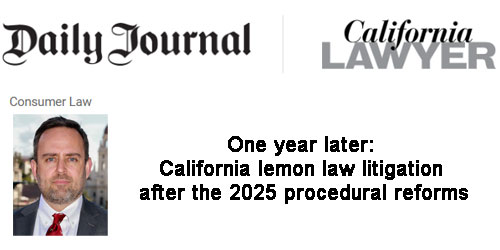
Joseph Kaufman & Associates is proud to announce that an article written by its CEO has been published in the Daily Journal.
You can read the article on the Daily Journal (with a subscription) or below
One year later: California lemon law litigation after the 2025 procedural reforms
By Joseph Kaufman
In 2025, California enacted sweeping procedural reforms governing a large segment of Song-Beverly Consumer Warranty Act litigation. Codified at Code of Civil Procedure sections 871.20 through 871.30, the reforms were intended to streamline lemon law litigation, encourage early resolution, reduce discovery disputes and address increasing judicial frustration with the growing volume of Song-Beverly filings. One year later, practitioners are beginning to see how the procedures are functioning in practice—and where significant issues remain.
The reforms did not emerge in a vacuum. They were the result of an increase in lemon law litigation throughout California over the last decade. Modern vehicles increasingly rely on complex software, electronic systems, sensors and driver-assistance technology. While these innovations improved vehicle functionality, they also increased warranty-related defects, dealership visits and software-based repair failures that often cannot be resolved through traditional mechanical repairs. The practical result of the advanced technologies is that more consumers now qualify for relief under California’s lemon law.
Consumer awareness also increased. Social media, online advertising, and consumer-focused marketing made California consumers far more aware of their Song-Beverly rights. At the same time, the business model of lemon law litigation evolved. Historically, Song-Beverly litigation was handled by a relatively small number of specialized firms. That changed when several firms adopted a high-volume, assembly-line approach to lemon law litigation. Intake, pleadings, discovery, and settlement procedures became heavily standardized, concentrating a significant percentage of statewide filings among a small number of firms. While most California lemon law attorneys continue to litigate manageable caseloads, a handful of high-volume firms dramatically increased filing volume and placed substantial pressure on California courts.
Court congestion increased, discovery disputes became commonplace, and frustration mounted on both sides. Manufacturers complained of mass-produced litigation, while plaintiffs argued that manufacturers delayed repurchase decisions, withheld internal documents, and forced unnecessary litigation. Ultimately, that environment created the political momentum necessary for procedural reform. The 2025 reforms emerged from negotiations involving manufacturers, defense counsel, consumer attorneys and the Consumer Attorneys of California. Manufacturers argued the litigation environment had become unmanageable, while consumer attorneys argued manufacturers delayed evaluating and resolving legitimate claims.
At a high level, the reforms were designed to encourage prelitigation and early-litigation resolution of claims, require expedited disclosures, standardize settlement procedures, limit discovery disputes, establish accelerated deposition deadlines, reduce gamesmanship surrounding confidentiality and create meaningful sanctions for non-compliance. Perhaps most importantly, the reforms attempted to force both sides to promptly evaluate cases rather than allowing litigation to drift for years before meaningful settlement discussions occurred.
One of the most important—and often overlooked—aspects of the reforms is that they do not automatically apply to every Song-Beverly case. The procedures apply only to manufacturers that affirmatively elect to participate in the statutory framework. Several major manufacturers have opted in, including General Motors, Ford, and FCA US LLC/Stellantis, and others. Many others have not. Companies such as Honda, Toyota, Volkswagen, BMW, Tesla, Porsche, and Mazda, to name a few, continue litigating Song-Beverly cases under ordinary California civil procedure. As a result, California now operates under a bifurcated lemon law system: one set of procedural rules for participating manufacturers and another for everyone else.
The reforms created both prelitigation obligations and an accelerated litigation framework once suit is filed. Under the new procedures, a consumer seeking civil penalty damages must first submit a written repurchase demand to the manufacturer before filing suit. If the vehicle qualifies for repurchase or replacement, the manufacturer must make an offer within 30 days and complete the repurchase or replacement within 60 days. Failure to comply with either deadline exposes the manufacturer to civil penalty liability.
Once litigation begins, the filing of the manufacturer’s responsive pleading stays traditional discovery pending completion of an early mediation process. Within 60 days after the responsive pleading is filed, both sides must exchange mandatory initial disclosures, including repair records, warranty information, repurchase evaluations, lemon law policies, customer communications and relevant ownership and financing documents. Mediation must then be scheduled within 90 days, party depositions lasting two hours or less must be completed within 120 days, and mediation itself must be completed within 150 days. Only after mediation is completed is the discovery stay lifted.
The legislative goal was clear: encourage early settlement discussions before the parties incur substantial litigation costs and avoid years of unnecessary discovery disputes. The reforms also attempted to standardize settlement agreements, restitution calculations and fee resolution procedures. The statute additionally created penalties of $50 per day against manufacturers that fail to timely complete repurchases or replacements in litigated cases.
Not all manufacturers embraced the framework. Several declined to opt in altogether, citing their inability to produce witnesses within the accelerated timelines. Critics, however, have argued that rather than committing adequate staffing and resources to comply with the deadlines, those manufacturers simply chose to avoid the procedures entirely.
While much attention has focused on the disclosure and mediation provisions, the sanctions framework may ultimately become the most consequential aspect of the reforms. Unlike ordinary civil litigation where continuances and informal extensions are common, the new procedures contemplate meaningful sanctions for parties and attorneys who fail to comply without substantial justification. Potential sanctions include monetary sanctions, evidentiary sanctions, dismissal without prejudice and restrictions on claims or defenses.
Importantly, the sanctions provisions target both sides. The framework appears specifically designed to address high-volume plaintiff firms filing more cases than they can effectively manage, as well as manufacturers using delay tactics to prolong litigation and avoid repurchase obligations. Plaintiff attorneys managing extremely large caseloads may struggle to comply with the accelerated disclosure, deposition, mediation and document production deadlines. Manufacturers similarly face exposure for failing to timely disclose information, produce witnesses or meaningfully participate in the process.
As judges become more familiar with the statute and more willing to impose sanctions, the reforms may begin accomplishing what the Legislature intended: discouraging abusive litigation practices on both sides. There is also a broader professional responsibility component embedded within the statute. Attorneys who take on more cases than they can competently manage may face not only litigation sanctions, but potentially professional discipline if repeated failures to comply with statutory obligations attract State Bar scrutiny.
Despite the Legislature’s attempt to create a comprehensive framework, several structural weaknesses remain. Most notably, participation remains voluntary for manufacturers, creating significant inconsistency depending on which manufacturer is involved. In time, the Legislature will need to address the inequities of a system where defendants can choose whether to participate in the procedures while consumers cannot. Additionally, practitioners can simply avoid the procedures altogether by strategically limiting the remedies sought.
Whether the reforms have succeeded depends largely on whom one asks. Participating manufacturers may argue the reforms created safeguards against abusive litigation practices. Consumer attorneys would respond that while some manufacturers are finally resolving more cases prelitigation, others continue employing many of the same tactics that existed before the reforms, including delaying repurchase decisions, conditioning disclosures on protective orders and aggressively restricting discovery. At the same time, courts now possess clearer statutory authority to sanction either side for failing to cooperate. That may ultimately become the most significant long-term effect of the reforms.
One year later, California’s lemon law procedural reforms have unquestionably altered Song-Beverly litigation for participating manufacturers. The reforms created an accelerated framework governing disclosures, mediation, depositions and settlement obligations while imposing meaningful sanctions for non-compliance. Whether the reforms ultimately succeed remains unclear. Participation remains voluntary, the system remains fragmented, and litigants on both sides continue testing the limits of the statute. As courts begin interpreting and enforcing the sanctions provisions, however, the pressure to promptly evaluate claims, cooperate in discovery and litigate efficiently will likely increase substantially.
Joseph A. Kaufman is the founder of Joseph Kaufman and Associates.


Write a comment: