






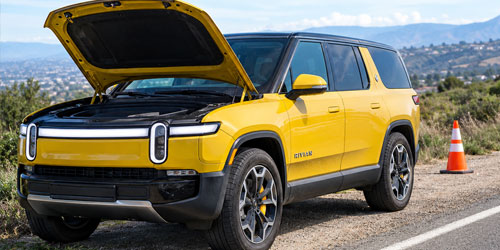
Rivian’s R1T pickup and R1S SUV earned fans for their performance and design, but they have also built a record of recalls, repeat repair visits and software headaches. For owners who keep returning to a Rivian Service Center for the same problem, one question comes up quickly: is my truck a lemon? This guide covers the Rivian problems owners and regulators discuss most, how those problems relate to California’s lemon law, and what to do if your vehicle keeps failing to get fixed.
When Is a Rivian a Lemon in California?
California’s Song-Beverly Consumer Warranty Act requires a manufacturer to repurchase or replace a new vehicle it cannot repair to warranty standards after a reasonable number of attempts. The Tanner Consumer Protection Act, part of that framework, creates a presumption that a vehicle is a lemon when, within 18 months of delivery or 18,000 miles, whichever comes first, one of these happens:
- A serious safety defect (one likely to cause death or serious bodily injury) is subject to repair two or more times without a fix.
- The same defect is subject to repair four or more times without a fix.
- The vehicle is out of service for repairs for more than 30 cumulative days.
The presumption is a legal shortcut, not a hard cutoff. Owners outside the 18-month window can still have a claim if the defect substantially impairs the vehicle’s use, value or safety and the manufacturer could not fix it after reasonable attempts. Every case turns on its repair history, which is why records matter so much.
The Most Common Rivian Problems
The table below summarizes the recurring issues, followed by details on each. Most of these come from NHTSA recalls and press and owner reporting; some are confirmed defects, others are complaint patterns that have not led to a recall.
| Issue | Models / Years | What was reported |
| Rear toe-link failure | 2022–2025 R1T and R1S | Recall of 19,641 vehicles after an older service procedure; separate NHTSA investigation |
| 12V battery faults | Gen 1 and Gen 2 | No-starts, error codes, unresponsive vehicle; OTA updates and part replacements |
| Software and digital key | All model years | Infotainment freezes, update failures, unreliable phone-key pairing |
| Accelerator pedal drift | 2022 R1T and R1S | Pedal may not register zero; NHTSA recall 23V-883 |
| Lighting defects | 2023–2026 | Headlight aim recall 24V-367; dead front turn signals on Gen 2 vehicles, recall 26V-508 |
| Seat belt retractor | 2022–2026 | Second-row retractor bolts improperly tightened; NHTSA recall 26V-003 |
| HVAC noise | R1T and R1S | Loud hum or vibration with AC in hot weather |
1. Rear Toe-Link Failure
In January 2026, Rivian recalled 19,641 R1 vehicles from model years 2022 to 2025 (12,610 R1T trucks and 7,031 R1S SUVs). Technicians who had serviced the rear suspension used an older procedure, and the toe-link joint may not have been reassembled correctly. A separated toe link could increase crash risk, and at least one crash has been reported. NHTSA also lists a broader preliminary investigation into rear toe-link failures that reportedly covers roughly 115,000 vehicles. Because the part affects steering and stability, a toe-link failure is the kind of defect that can qualify as a serious safety issue.
2. 12V Auxiliary Battery Failures
Rivians rely on a 12V battery to power vehicle electronics, so a failure can leave the vehicle unable to start, throwing error codes or completely unresponsive even though the main traction battery is fine. Owners of Gen 2 models report a poorly designed battery bracket under the passenger seat that can corrode and damage the battery case, while owners of earlier vehicles report standby drain and frequent wake-ups. Rivian has said a software bug in a small number of vehicles could trigger 12V resets, and it has replaced batteries and brackets on affected vehicles.
3. Software Glitches and Digital Key Problems
Infotainment freezes, reboots, failed over-the-air (OTA) updates and Driver+ disable events are among the most frequent owner complaints, and independent reviewers describe them as frustrating more often than dangerous. Owners also report that the phone-as-key feature pairs unreliably, disconnects unexpectedly, or fails to lock and unlock the vehicle by proximity. A software problem can still support a lemon law claim when it persists after repeated repair attempts and affects the vehicle’s use or safety.
4. Accelerator Pedal Drift
NHTSA recall 23V-883 covers early 2022 vehicles whose accelerator pedal may not register a true zero position, which can prevent the vehicle from entering auto-hold or park as expected. Separately, some 2026 R1S owners have filed NHTSA complaints describing unexpected acceleration or power loss; these are complaint reports rather than confirmed defects, but they show why repeated drivability problems deserve prompt documentation.
5. Headlight and Front Lamp Defects
Recall 24V-367 addressed headlights that shipped with incorrect aim on 2023–2024 vehicles, which can reduce visibility and increase crash risk. More recently, defective front lamp assemblies on Gen 2 R1T and R1S vehicles can leave one or both front turn signals dead. Rivian expanded the population under NHTSA campaign 26V-508 to include 625 additional 2025–2026 R1T trucks alongside 3,204 R1S SUVs. Exterior lighting has also been a recurring theme in complaints and recalls for the 2025 R1S.
6. Second-Row Seat Belt Retractors
NHTSA recall 26V-003 covers 2022–2025 R1T and 2022–2026 R1S vehicles in which second-row retractor bolts may not have been tightened properly, reducing the restraint’s effectiveness in a crash.
7. HVAC Noise and Climate Control
Owners report a deep hum or vibration when the air conditioning runs in hot weather, often with the cabin above 90°F and the system in Auto mode. Some owners say a compressor replacement or a software update helped, while others report being told the noise is within design specification. Heating problems also appear among 2025 R1S complaints.
8. Suspension, Driveline and Battery or Charging Complaints
Reviewers point to front-end and driveline hardware such as half-shafts, control arms and dampers as a recurring trouble area, and note that Consumer Reports and owner surveys placed Rivian near the bottom of 2025 reliability rankings. Other owners report range inconsistency, battery calibration errors and charging failures. Many of these issues are intermittent, which makes written repair orders even more important.
Do Recalls and Software Updates Affect a Lemon Law Claim?
A recall is strong evidence that a defect exists, but it does not automatically make a vehicle a lemon, and a completed recall repair does not automatically end a claim. What matters is whether the defect was fixed and whether the vehicle conforms to its warranty. Rivian’s official recall page lets owners check open campaigns by VIN. Likewise, an OTA update does not erase earlier repair attempts; if the symptom returned after an update, that service visit generally still counts toward the repair history. If an update itself created a new problem, that may be a separate warranty issue.
What to Do If You Think Your Rivian Is a Lemon
- Keep every repair order. Make sure each visit lists your complaint, the dates the vehicle was in the shop and any work performed. Ask the service center to write down your exact complaint if they will not.
- Track days out of service. Total the days the vehicle sat at the service center, including any time awaiting parts.
- Report problems in writing. Use the Rivian app, email or the service portal so there is a dated record, and save screenshots of warning messages and error codes.
- Check recalls by VIN. Confirm whether your defect is covered by an open or completed recall.
- Review your warranty. Read the new vehicle limited warranty and any dispute-resolution terms in your purchase or lease documents.
- Talk to a California lemon law attorney early. Many consumer lemon law attorneys offer free evaluations, and under Song-Beverly the manufacturer pays reasonable attorney fees when the consumer prevails.
A Note on California’s New Lemon Law Procedures
California changed its lemon law procedures with AB 1755, effective January 1, 2025, and the follow-up bill SB 26, signed April 2, 2025. Manufacturers can now opt in to the newer process, which includes a pre-suit written notice, set deadlines for the manufacturer to respond, and binding arbitration of attorney fee disputes before litigation. Manufacturers that do not opt in remain subject to the existing Song-Beverly procedures. Which track applies to your vehicle depends on the manufacturer’s election, so confirm it with an attorney or through the Department of Consumer Affairs before you send any demand letter.
Bottom Line
Rivian continues to address problems through recalls, service campaigns and software updates, and many owners have trouble-free vehicles. But a defect that keeps coming back, especially one that affects safety, steering, power or starting, is exactly what California’s lemon law was written to address. If your R1T or R1S is spending more time at the service center than in your driveway, start documenting now and get an expert opinion on your options. This article is general information, not legal advice.
Frequently Asked Questions
Does a recall automatically make my Rivian a lemon?
No. A recall shows that a defect exists, but a lemon law claim depends on whether the defect substantially impairs the vehicle and whether Rivian fixed it after a reasonable number of attempts. A recall repair that works may resolve the issue; one that fails or returns can strengthen a claim.
How many repair attempts does California require?
The lemon presumption applies after two or more attempts for a serious safety defect, four or more attempts for the same problem, or more than 30 cumulative days out of service, all within 18 months or 18,000 miles of delivery. Claims can still succeed outside those limits depending on the facts.
Do over-the-air software updates count as repair attempts?
A service visit where Rivian addressed your complaint, including by installing a software fix, generally counts toward your repair history, particularly if the symptom came back. Ask your attorney how your specific history applies.
Are leased and used Rivians covered?
Leased vehicles are covered, and used vehicles can qualify under some consumer protection statutes depending on the warranty status. The vehicle must have been purchased or leased at retail in California.
What can I recover if my Rivian qualifies?
Remedies can include a repurchase (generally the amount you paid, including taxes, registration and finance charges, less a mileage offset), or a replacement vehicle. Courts can also award civil penalties for willful violations, and the manufacturer pays reasonable attorney fees if you prevail.
Does it cost anything to hire a lemon law attorney?
Most consumer lemon law attorneys work on a fee-shifting basis, meaning the manufacturer pays fees if the claim succeeds. Confirm the fee terms in writing before you sign.
Which new California rules apply to my claim?
It depends on whether Rivian has opted in to the AB 1755 and SB 26 procedures. The California Department of Consumer Affairs publishes the list of manufacturers that opted in, and it explains the process.
How Joseph Kaufman & Associates Can Help You With Your Rivian Lemon Problems
If you’re experiencing issues with a 2020 – 2026 Rivian vehicle which haven’t been fixed in a reasonable number of attempts while under warranty, Joseph Kaufman and Associates can help you file a lemon claim seeking a repurchase or cash settlement.
Our team brings unparalleled experience and has recovered over $150 million on behalf of consumers and vehicle owners like you.
Please fill out the form below including any documentation you have regarding your vehicle’s issues and repairs. A lemon law attorney will review your info and set up a free consultation to let you know if you qualify for lemon law help.
Fill out this form to Get Your Free Rivian Lemon Law Consultation
This article is for general information only and is not legal advice. Lemon law rules change and depend on the facts of each case.
References
NHTSA Safety Recall 23V-883 – Rivian Accelerator Pedal Drift. https://static.nhtsa.gov/odi/rcl/2023/RCLRPT-23V883-7728.PDF
NHTSA Safety Recall 24V-367 – Rivian Headlight Aim. https://static.nhtsa.gov/odi/rcl/2024/RCLRPT-24V367-7310.PDF
NHTSA – Rivian R1T vehicle page (recalls, complaints and investigations). https://www.nhtsa.gov/vehicle/2024/RIVIAN/R1T
BGR – 4 Common Problems People Are Having With The Rivian R1 (February 17, 2026). https://bgr.com/2100424/rivian-r1-ev-common-problems/
Recharged – Rivian R1S Common Problems in 2026. https://recharged.com/articles/rivian-r1s-common-problems-2026
Recharged – Rivian R1S Common Problems and Fixes: 2026 Reliability Guide. https://recharged.com/articles/rivian-r1s-common-problems-and-fixes/
Au7o – 2026 Rivian R1T Problems: Known Issues (includes NHTSA campaign 26V-508). https://www.au7o.io/known-issues/rivian-r1t?year=2026
NHTSA Safety Recall 26V-003 – Rivian Second-Row Seat Belt Retractor. https://static.nhtsa.gov/odi/rcl/2026/RCLRPT-26V003-2661.pdf
California Civil Code § 1793.22 – Tanner Consumer Protection Act. https://leginfo.legislature.ca.gov/faces/codes_displaySection.xhtml?lawCode=CIV§ionNum=1793.22.
California Song-Beverly Consumer Warranty Act, Civil Code §§ 1790–1795.7. https://leginfo.legislature.ca.gov/faces/codes_displayText.xhtml?lawCode=CIV&division=3.&title=1.7.&part=4.&chapter=1.&article=3.
California Department of Consumer Affairs, Arbitration Certification Program – New Lemon Law Procedures (AB 1755 / SB 26). https://www.dca.ca.gov/acp/new_lemon_law.shtml
Rivian – Official Recall Information. https://rivian.com/support/article/recall-information
Rivian – R1T + R1S New Vehicle Limited Warranty Guide (effective December 31, 2024). https://assets.rivian.com/2md5qhoeajym/4Gu8v9hXmik94CHAKis9mG/c6008f410cac191abd746bd60274bb22/r1t_r1s-new-vehicle-limited-warranty-guide-us-en-us-20241231.pdf


Write a comment: